Digital Leak Correlation Testing in Santa Fe, NM
On long pipe runs, listening by ear isn't enough. Digital correlators use sensors at two points and precise mathematics to calculate the leak's position — even on large-diameter mains.
Understanding Digital Leak Correlation Testing in Santa Fe
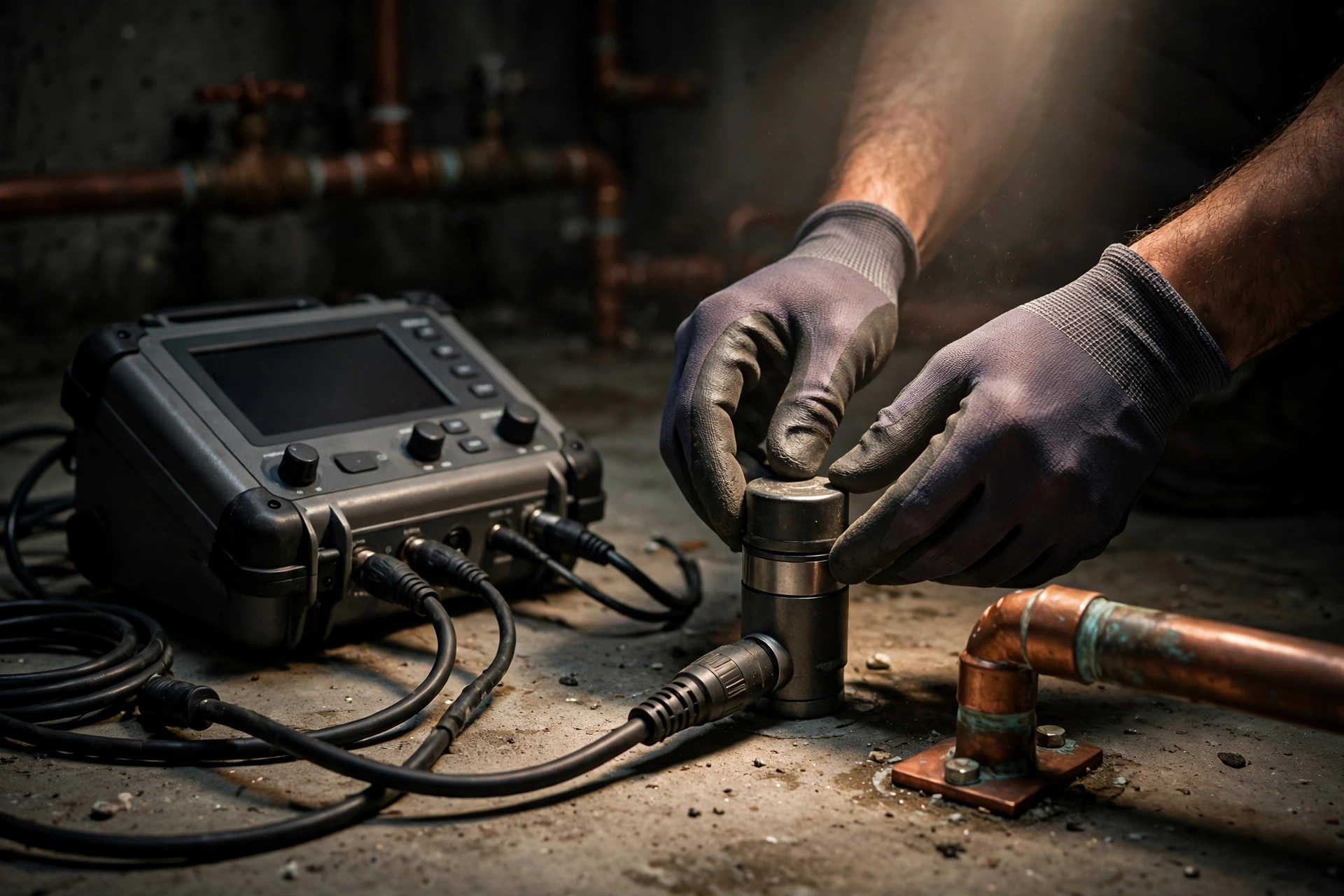
Digital leak correlation is the engineering-grade answer to leaks on long or large-diameter pipe runs — water mains, campus loops, long service lines, and commercial sites. Two acoustic sensors attach to the pipe at known points (valves, hydrants, meters); both hear the leak's noise, and the correlator calculates the exact position from the time delay between them, using the pipe's diameter, length, and material.
Where a ground microphone gives a skilled technician a neighborhood, correlation gives a measurement — often within feet on runs hundreds of feet long. In the Santa Fe area it serves utilities, campuses, large commercial properties, and rural properties with very long service lines. (New Mexico's NMED even runs a LeakTracer satellite program for water-system loss — correlation is the ground-truth method that pinpoints what remote sensing flags.)
Signs You May Need Digital Leak Correlation Testing
If any of these sound familiar, don't wait — hidden problems compound daily.
Unlocated leak on a long main
A confirmed water loss with no position — the line is too long to search by ear.
Large-diameter pipe suspected
Mains and campus loops where the leak's sound spreads too far for ground microphones.
High non-revenue water loss
Utilities and large properties losing significant volume with no visible break.
Multiple possible branches
Correlation distinguishes which branch of a network actually leaks.
Post-remote-sensing confirmation
Satellite or district-metering flags a zone; correlation pinpoints the pipe.
Our Digital Leak Correlation Testing Process
Thorough, transparent, and built around one visit that answers everything.
Network review
We map the pipe run: access points, diameter, length, and material — the correlator's required inputs.
Sensor deployment
Calibrated acoustic sensors attach to the pipe at two bracketing points, often a valve and a hydrant.
Correlation measurement
The system records leak noise at both sensors and computes the position from arrival-time differences.
Surface confirmation
Ground microphones verify the calculated point from above.
Marked position & report
The leak is marked with survey-grade references and documented for the repair crew or utility.
Technology We Use for Digital Leak Correlation Testing
Professional-grade methods — matched to your situation.
Digital leak correlators
Dual-sensor systems with software that triangulates leak position from sound-delay analysis.
Acoustic loggers
Deployed overnight on networks to catch leaks that show best during quiet minimum-night-flow hours.
Pipe parameter modeling
Diameter, length, and material inputs let the software compute accurate positions on any pipe type.
GIS-referenced marking
Positions documented against maps and landmarks for precise excavation.
Benefits of Professional Digital Leak Correlation Testing
Finding it fast — and precisely — changes everything about what happens next.
Precision on long runs
Measures the position instead of estimating it — critical when the run is hundreds of feet.
Works on large diameters
Where ground microphones lose the signal on big mains, correlators still compute.
Minimal excavation
Utilities and campuses avoid trenching long sections to search — one calculated dig.
Network-level answers
Identifies which branch leaks in complex systems, directing crews correctly the first time.
Property Types We Serve
Digital Leak Correlation Testing — FAQs
How does a digital leak detection system work?
Two acoustic sensors attach to the pipe at known access points. Both hear the leak's noise; the correlator measures the tiny time difference between arrivals and — using the pipe's diameter, length, and material — calculates the leak's exact position along the run.
What pipe information does a correlator need?
The distance between the two sensors, the pipe's diameter and material, and the access point locations. Accurate inputs produce accurate positions — which is why the pre-survey matters.
When is correlation used instead of acoustic listening?
On long pipe runs, large-diameter mains, and complex networks where a ground microphone can only narrow the area. Correlation measures the position; listening estimates it. For short residential lines, standard acoustic work is usually sufficient.
Can correlation find leaks in large or long pipelines?
That is precisely its strength. Correlators are designed for exactly this case — long transmission mains, campus loops, and distribution networks where the leak could be anywhere along hundreds or thousands of feet of pipe.
Related Services
Acoustic Pipe Leak Detection
Pressurized water escaping a pipe makes a distinct vibration — inaudible to you, crystal clear to our sensors.…
Learn more →🕳️Underground Water Line Leak Detection
A buried supply line can leak thousands of gallons into the soil with nothing visible on the surface. We trace…
Learn more →🔧Main Water Line Leak Detection
The service line from your street meter to your house is your responsibility — and when it breaks, the water (…
Learn more →🏢Commercial Water Loss Auditing
Hotels, restaurants, offices, and multifamily properties can lose thousands of gallons — and thousands of doll…
Learn more →Suspect a digital leak correlation testing issue in Santa Fe?
Don't wait until a small leak becomes a big repair. Call now — we answer 24/7 and pinpoint it without tearing your property apart.